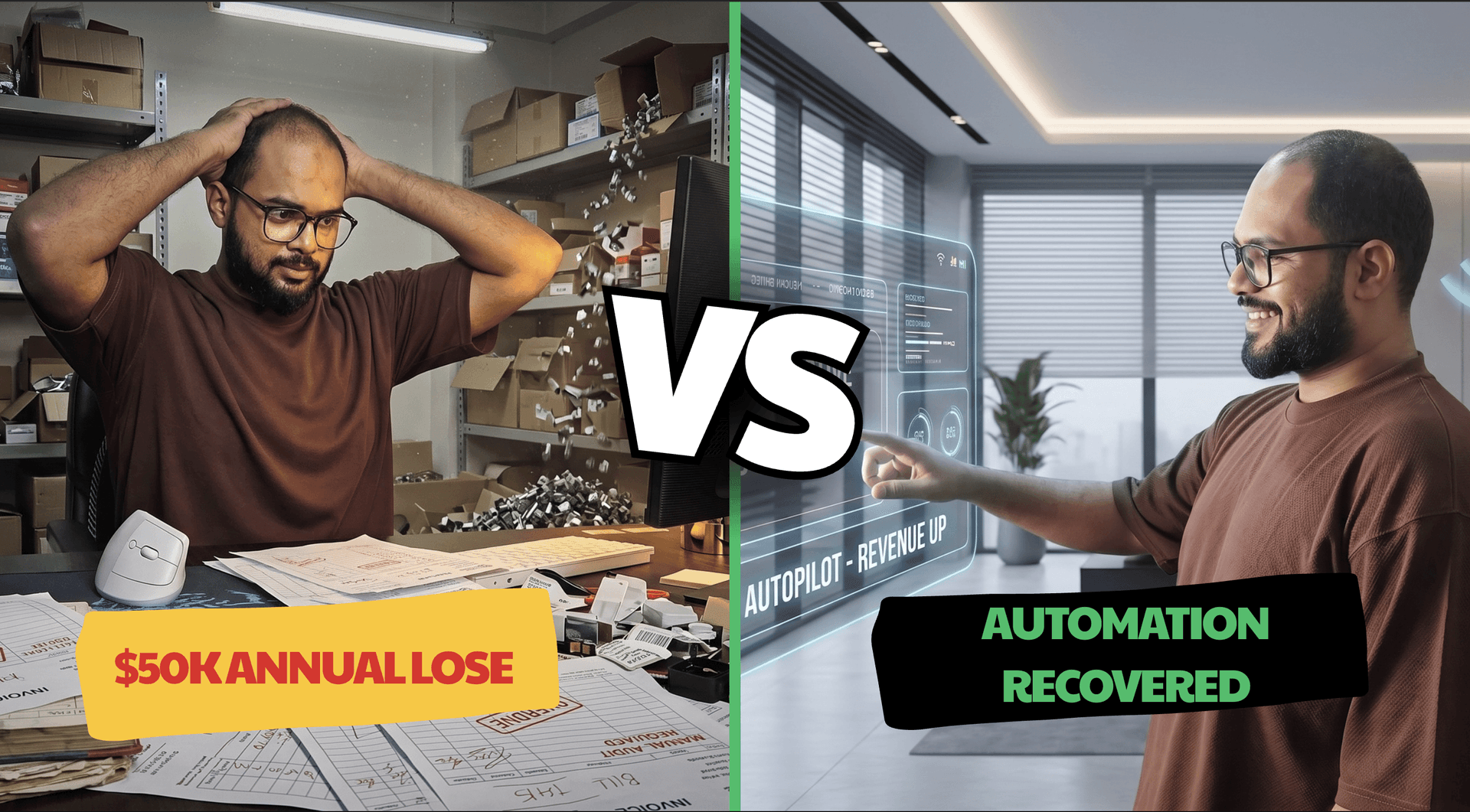
Why Mid-Market E-Commerce Brands Lose $50K+ Annually to Manual Processes (And How to Fix It)
Mid-market e-commerce brands lose $50,000–$80,000 a year to manual data entry, order errors, and delayed fulfillment. Here’s where the money goes — and how automation gets it back within 90 days.
Why Mid-Market E-Commerce Brands Lose $50K+ Annually to Manual Processes (And How to Fix It)
Last updated: August 2026. Originally published 2025; refreshed with current cost figures, updated tooling, and a new ROI calculation section.

Picture a brand doing $5M a year: twelve staff, healthy margins on paper, growing steadily. But every day, two of those twelve spend most of their hours copy-pasting orders between systems, manually updating spreadsheets, and chasing suppliers over email. Nobody budgeted for that — it just accumulated, one workaround at a time.
Based on our client engagements, a mid-market e-commerce brand — roughly 30 to 200 orders a day — loses $50,000–$80,000 annually to manual processes: labor hours on repetitive data entry, order errors and the refunds they trigger, delayed fulfillment, inventory discrepancies, and decisions made on stale numbers. In this post we break down exactly where those losses hide, give you a 10-minute formula to calculate your own exposure, and show what fixing it actually looks like — including realistic costs and timelines.
What counts as a "manual process" in e-commerce?
A manual process is any recurring task where a human does work a system could complete: re-typing order details from your storefront into your accounting tool, updating stock levels across marketplaces by hand, generating invoices one at a time, pasting tracking numbers into emails. Individually each takes minutes. At mid-market volume they compound into entire salaries — and unlike at the startup stage, at 30–200 orders a day the workarounds stop being scrappy and start being structural. This is the stage where manual operations hurt most: too much volume to absorb the errors, not yet the headcount of an enterprise ops team.
Where is the $50K+ actually going? The five hidden cost buckets
1. Labor hours on repetitive data entry
Operations staff at this stage commonly spend 30–40% of their day on tasks that could be automated. The math is uncomfortable: two staff members spending 3 hours a day at $20/hour is 2 × 3 × $20 × 350 working days ≈ $42,000 a year — before you count the manager who reviews their work. Even a conservative version of this calculation usually lands above $30,000 in data entry alone.
2. Order errors and customer refunds
Manual order handling carries a 1–4% error rate in practice — wrong SKUs, wrong addresses, missed line items. At $50,000 in monthly orders, every 1% of errors is roughly $500 a month in direct refund and reshipping costs, $6,000+ a year per error-percent. The hidden multiplier is worse: a customer who receives the wrong item rarely complains twice — they just don’t come back, and the loss never shows up labeled as an error cost.
3. Delayed fulfillment and abandoned repeat purchases
When a human has to touch every order before it ships, fulfillment inherits their working hours: orders placed Friday evening move Monday morning. Manual workflows routinely add 4–24 hours to processing time, and in 2026 shipping speed is table stakes—slow first delivery measurably suppresses repeat purchase rate, which is where mid-market margins actually live.
4. Inventory discrepancies and stockouts
Selling on Shopify, Amazon, and a wholesale channel with manually reconciled stock means one of two failure modes is always running: overselling (refunds, apologies, and marketplace penalties) or padding safety stock (cash locked in inventory). Brands reconciling by hand typically see stockout claims of several percent of lost annual sales—4% on $1.5M is $60,000 in revenue that simply never happened.
5. Reporting and decision lag
When reporting means exporting CSVs and assembling a spreadsheet, leadership decides on last week’s reality: ad spend keeps flowing into a product that’s about to stock out; a margin problem surfaces a month late. This bucket is the hardest to price and often the most expensive—missed decisions compound.
How do you calculate your own manual process cost?
Ten minutes, three numbers:
Labor: (hours per week your team spends on repetitive tasks) × (loaded hourly cost) × 52.
Errors: monthly order value × your error rate (if you don’t track it, assume 2%) × 12.
Stockouts: estimated lost sales from the last 12 months of out-of-stock periods — your marketplace dashboards already show this.
Add the three. Most founders doing this exercise for the first time land between $40,000 and $100,000 — and that’s before the un-priceable buckets (reporting lag, churn from bad experiences). If you’d rather have us run it with you, the audit is free Contact.
What does automation actually look like in practice?
A concrete example from the builds we do: an order lands on Shopify. Automatically — with zero human touch — the warehouse system pulls it, the tracking number flows back to the customer, inventory decrements across every sales channel, and the accounting entry is created. That entire chain is one n8n workflow n8n Automation service.
We build these as custom, self-hosted n8n systems rather than chains of per-task tools — n8n connects over 500 integrations natively [link: https://n8n.io/integrations — the outside source for the checklist], including Shopify, WooCommerce, ShipStation, QuickBooks, and Klaviyo, and doesn’t charge per operation, which is exactly what matters at order volume. Where judgment is involved — flagging suspicious orders, drafting supplier emails, routing support tickets — an AI agent sits inside the workflow AI Agent Development. For brands whose operations have outgrown every off-the-shelf tool, the same discovery process feeds a custom platform build E-Commerce Development.
Why does e-commerce automation fail for established brands?
E-commerce automation usually fails at established brands for three reasons: it automates a broken process instead of fixing it first, it connects tools point-to-point with no single source of truth for orders and inventory, and nobody owns monitoring, so silent failures pile up. Fix the process, centralize the data, then automate, and assign an owner.
A common pattern: a new Zap, script or app gets added for every new pain point until nobody knows which system holds the correct order status or stock level. The fix is rarely more automation. It is choosing one system of record for orders, inventory and customers, documenting how each process should work, and rebuilding the automations around that record, with alerts when something fails.
What should mid-market brands automate first?
Start where volume and the cost of errors are highest. For most mid-market brands, this order pays back fastest:
Process | What gets automated | Typical tools | Why it comes first |
|---|---|---|---|
Order sync across channels | Orders from Shopify, Amazon and wholesale flow into one order or ERP system | n8n, native connectors, ERP APIs | Removes re-keying and most order errors |
Inventory sync | Stock levels update across every channel in near real time | n8n, inventory apps | Prevents overselling and stockouts |
Returns and refunds | Return requests, labels, restocking and refund status | Returns apps plus n8n | High-touch, error-prone and customer-facing |
Customer notifications | Order, shipping and delay updates by email, SMS or WhatsApp | Klaviyo, WhatsApp Business API, n8n | Cuts "where is my order?" tickets |
Reporting | Daily sales, margin and stock reports built automatically | n8n, Google Sheets or a BI tool | Faster decisions without CSV exports |
Want a second opinion on where your manual hours are going? See how we build n8n automations and e-commerce systems for growing brands.
How long does it take to see ROI from e-commerce automation?

Faster than most founders expect, because the losses are continuous: most businesses see measurable labor reduction within 30 days of their first workflow deployment, and full return on a typical $3,000–$20,000 automation project within 60–90 days [→ see real price ranges in our custom software cost guide]. Automation is also a one-time build cost against a recurring loss — the $50K doesn’t stop leaving on its own, and it scales up with your order volume.
One honest caveat: $50K+ is our conservative estimate for brands in this range — for many it’s higher, and for brands under ~20 orders a day it’s lower and off-the-shelf tools are usually the right answer. The fix isn’t hiring more people; it’s removing the manual bottlenecks so the people you have do work that grows the business.
At Ryven Global, we specialize in custom-built automation systems for mid-market e-commerce brands — book a free process audit and we’ll show you your number, and exactly which workflow to automate first [→ Contact / cal.com/ryven]. More questions? See all FAQs
Sifat Kazi — Founder of Ryven Global LLC, a business automation and custom software agency helping mid-market e-commerce and real estate companies eliminate operational bottlenecks through custom-built automation systems.